Relations Between Orientalist Authors and Their Writings
Traveling Through Time with Orientalist Authors
Edward W. Said, Palestinian writer and professor of literature at Columbia University, defined orientalism as a way to describe and emphasize the difference between the Eastern World and the West. “Orient” actually extends from North Africa to Asia, passing by the Middle East. Although a lot of people nowadays think that orientalism has vanished, the Western World hasn’t stopped pointing out the differences and emphasize the disparities between them and the Eastern world through many forms: paintings, songs, books, etc.
For this reason, and since we are living in Lebanon, an oriental country, we are here today studying and pointing out the different relations of Orientalism and mainly the different relations between orientalist authors. We would like to study how the Western world perceives us and understand how different authors, coming from different backgrounds, describe our Eastern world.

In order to reach this goal, our team met together through Zoom application and divided the work between the three of us.
We had started by gathering information from a master spreadsheet, prepared by Dr. Najla Jarkas and her students, that contains information on orientalist writers, their works and details that may or may not be relevant to our study. The information gathered was put in a separate, smaller spreadsheet that showed authors’ names, nationality, their category (i.e. whether the writer is an author, doctor, a journalist, a soldier, etc.), the title of their work, the category of the work (i.e. whether the work is a fiction, history, diary, etc.), the date of publishing, and the authors’ genders. Doing so allows us to see the different sections we can categorize.

Digging deeper in the spreadsheet, we realized that we can see some similarities in the data. For example, we saw that a big part of the writers came from the UK. We even realized that most of the writers were male. This led us to think about whether there are different relations between the orientalist authors and whether these relations had a deeper meaning.
In order to do so, the best tool to point out these relations is Palladio. Palladio is a DH tool, in which we insert the spreadsheet and it automatically creates relations between the categories by drawing graphs and networks and grouping common categories together.
We faced many obstacles and difficulties while working on the project, but we definitely took the necessary steps to overcome the issues we faced. The first issue we faced was when we began working on our Orientalist spreadsheet, we noticed a few inconsistencies and discrepancies with the date that was on the spreadsheet. In order to eliminate these discrepancies and inconsistencies we decided to standardize each metric and by doing so that will make the data on the spreadsheet richer and will keep things smooth and consistent. By doing so we hope that future students of ENGL 256D will benefit from our efforts and use the spreadsheet with ease. Another obstacle we faced that was not expected was because of the given current global pandemic it made working on our project collectively a challenge. As before the pandemic we used to meet up in person and work together and we realized that meeting in person definitely helped us be more efficient and effective with our work.
After observing the similarities in the spreadsheet, we decided to dig deeper into specific relations by creating research questions on which our project will be structured. Below we summarized our research questions to date and draw attention to them, and they help us decide which aspects we will be focusing on when we analyze the data from the Orientalist Project Spreadsheet on Palladio
- Which gender were mainly orientalist authors?
- Which country do the majority of orientalist authors come from?
- Throughout which years were the majority of orientalist books published?
- What is the relation between the text categories and the publication dates?
The reason why we came up with these questions is because we realised that there were a lot of similarities regarding these matters within the spreadsheet.
Once we gathered all the information on the spreadsheet, we noticed a few similarities and differences between a few of the entries. Therefore, due to these differences we thought of diving in and wanted to further analyze these differences that pertained to the author’s demographics like gender, origin, age etc..
After placing our data, found on our/ spreadsheet, on Palladio, we were able to come up with general realizations and we were able to take these results to another level.
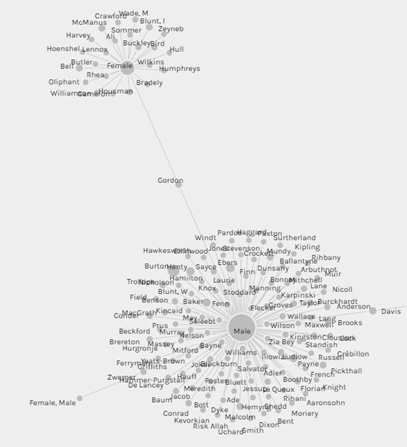
In fact, we have studied the gender or the authors that we researched, and we found that more than 80% of the orientalists were male. This finding didn’t mean that there weren’t more female authors in the world, but our data was rather male-centered.
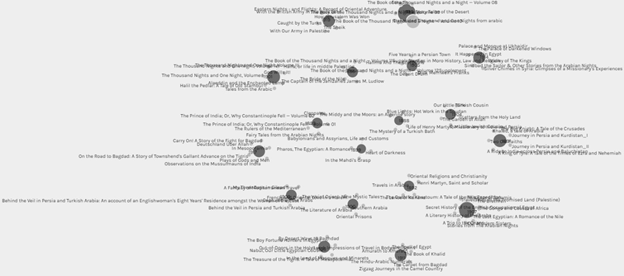
Moreover, we have discovered that the books or writings published, of the data we have, were mainly published during the end of the 19th century, towards the beginning of the 20th century. In fact, these publications were mostly made after the year 1885.
In reality, this is where things became more interesting from our end. We have compared these dates of publications with the feelings or emotions with the publication dates.
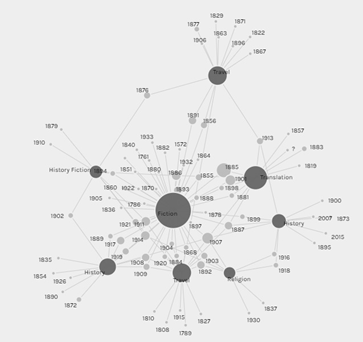
What is surprising is that we actually found a relation between these 2 and we didn’t actually expect that at first. We can clearly see that, during the 18th century, even though we didn’t have much data compared to other centuries, publications were mainly centered around travel and fiction. In fact, after extensive research, and after digging deeper in these publications, we can see that this was due to the constant travel of the writers to Turkey (what was mainly known as Constantinople in the Roman Empire), Egypt, Morocco and Syria.
On the other hand, the writings of the 19th century were more focused on fiction and on history. In fact, this was done to describe folklore, and philosophies to create a literary environment of colonial exploration from a distinctly European worldview.
As for the 21st century, we only had 2 writings from 2007 and 2015, which aren’t very representative, but they mainly focused on history.
Since we have detailed the relations we have within our data, we were able to have a better look and understand what was missing within our data. For the next batch of students, we would then recommend to include more female authors in order to have more comprehensive data. Moreover, we believe that we should include more writers coming from other countries than the UK and USA and have a more even spread of the authors in the countries. In addition to that, as we mentioned earlier, we think that it would be better if we include more recent works. This way we would be able to study the evolution of Orientalism throughout the centuries.
This project couldn’t be done without the help of my team that consists of myself, Maha Younes and Karim Saridar.
Please feel free to give me any comment and feedback if you wish 🙂
References:
http://hdlab.stanford.edu/palladio-app/#/visualization
 Joseph’s Blog